

Verification & validation
Proof that the device meets its requirements and works in real hands. Every protocol traces back to the risk file held under ISO 14971.
When verification and validation are the right step
When the design is stable enough to test against its requirements. Verification and validation turn the design file into evidence a regulator and an auditor can check.

Prove each requirement
Bench tests that show each design output meets the design input it answers.

Show it works for users
Design validation and summative usability testing with real users in realistic conditions.

Prepare for accredited labs
Protocols, samples and pre-checks before safety, EMC or biocompatibility testing at an accredited lab.
What you bring, and what you get back
You bring
- Design inputs and requirements
- The risk management file
- Design outputs: drawings, schematics and software
- Units to test, built the way production will build them
- Any test results so far
You get back
- Verification and validation plan
- Test protocols with acceptance criteria
- Test reports
- Accredited lab reports, where a standard needs them
- Requirements trace matrix
- Summative usability report
Verification and validation answer different questions
Verification asks whether each design output meets its design input, usually on the bench. Validation asks whether the device meets the user's needs for its intended use, with real users in realistic conditions. ISO 13485 expects validation on initial production units or their equivalent, so units built by hand in the lab may not count. A device can pass every verification test and still fail validation.
How verification and validation work
Questions clients ask
When should verification and validation planning start?
When the requirements are written. A requirement that cannot be tested cannot be verified, so the plan checks each one early, while it can still be rewritten.
How many samples do we test?
The plan sets it for each test from the risk of failure and the confidence needed, and records why. Some standards also set a minimum.
Which tests need an accredited lab?
Tests to recognised standards, such as IEC 60601-1 electrical safety and IEC 60601-1-2 EMC, are usually run at a lab accredited to ISO/IEC 17025. Many other tests can run in-house under a controlled protocol.
What is a trace matrix?
A table that links each requirement to its design output, its risk controls and the test that proves it. It shows a reviewer that nothing was missed. See the design history file.
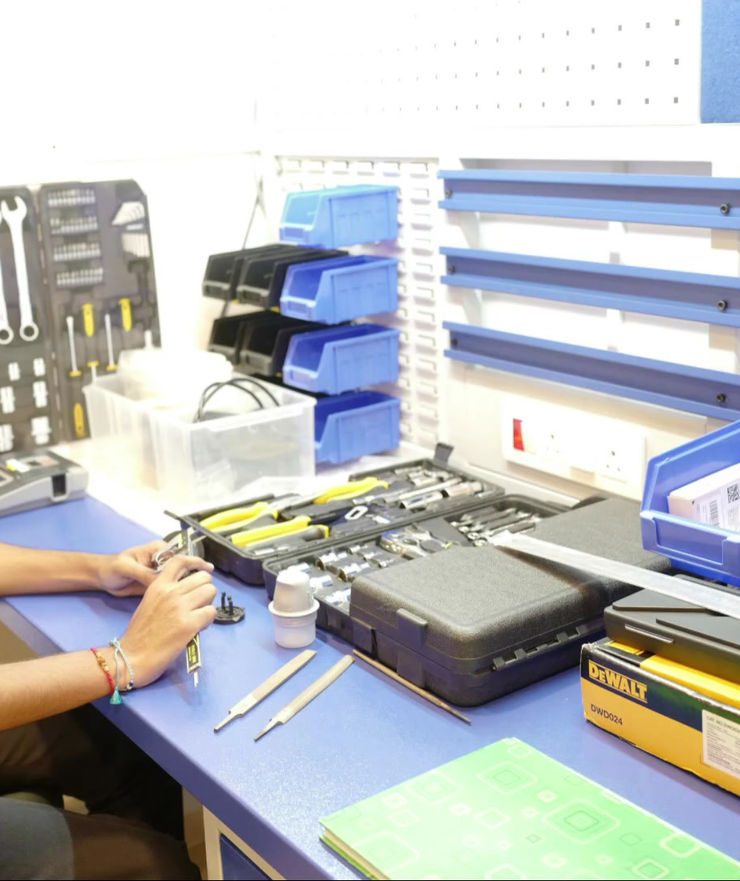
Tested in-house and at accredited labs
Tests run in our own labs in Navi Mumbai, and at accredited labs for the standards that need them. Verification is one of nine disciplines in one team, so the test engineers work beside the designers.
Devices we have worked on
We name the type of device, not the client. Client work stays confidential. See every device type.
- Pulsed lavage irrigation system for orthopaedic surgery
- Battery-powered bone drill with its docking station
- Suturing device for wound closure
- Manual wound debridement instrument set
- Bipolar coagulation instrument for neurosurgery
- Blood and fluid warmer, in two flow ranges
Run under an ISO 13485:2016 quality system certified by TÜV SÜD, certificate 99 400 00046. What it covers.
Not quite you?
Standards this work is done against
- ISO 14971Risk management
- IEC 62366-1Usability engineering
- IEC 60601 seriesElectrical safety and EMC, at accredited labs
- ISO/IEC 17025Competence of the testing laboratories used
The list for a given device, and the edition of each, is set in its regulatory plan.
Where this sits
Also in Co-Design & Develop
Tools for this

Have a question about Verification & validation?
Opens the contact form with this service named. Nothing is sent until you press send.